

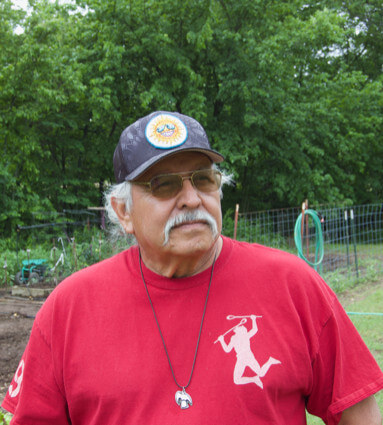
William D. Glass
William “Bill” Glass is a tribal member of the Cherokee Nation of Oklahoma and a Cherokee National Treasure. He is a ceramic artist and describes his practice, “I work with the clay but not to totally dominate it, letting its spirit coincide with mine. I am still amazed when I open up the kiln to see what the bond between the clay and myself has created.” In 1978, he established Bill Glass Ceramic Studio in Locust Grove, Oklahoma, and in 2001, opened Glass Studio with his son, Demos Glass. He has studied ceramics at both Central State University in Edmond, Oklahoma, and the Institute of American Indian Arts in Santa Fe, New Mexico. His work can be found in the following museum collections: the National Museum of the American Indian; Smithsonian Institution; Institute of American Indian Arts Alumni Museum, Santa Fe, New Mexico; the Atlanta History Center; the Heard Museum, Phoenix, Arizona; the Five Civilized Tribes Museum, Muskogee, Oklahoma; the Cherokee Historical Society Museum, Tahlequah, Oklahoma; and the Stovall Museum, Norman, Oklahoma. His public art commissions through Glass Studio include lead artist for works at “Passage,” in Chattanooga, Tennessee; “Touch to Above and The Four Elements” in the entryway at the First Americans Museum, Oklahoma City, Oklahoma; the floor medallions at the BOK Center in Tulsa; and the “Migration Story” stairway at the Cherokee History Museum, Tahlequah, Oklahoma.